





Abstract
The landscape of neuromodulation therapy is changing rapidly. Accelerated transcranial magnetic stimulation (TMS) protocols now compress 6-week depression treatment courses into as little as 5 days. Exploratory studies of a single-day regimen have reported remission rates of 49–72% in treatment-resistant depression (TRD).
Three converging principles define this shift: acceleration (compressing treatment from weeks to hours); augmentation (pharmacologically enhancing synaptic plasticity); and precision targeting (connectome-informed, individualized site selection). This narrative review synthesizes evidence across all 3 domains, with an emphasis on studies published from 2022 to 2026.
Key milestones include a second sham-controlled RCT confirming the efficacy of the SAINT/SNT (Stanford Accelerated Intelligent Neuromodulation Therapy) protocol and the first clinical description of a single-day TMS regimen (ONE-D (Optimized, Neuroplasticity-Enhanced techniques in Depression)) that leverages pharmacological augmentation with D-cycloserine (DCS) to enhance neuroplasticity. Precision strategies, including resting-state functional connectivity magnetic resonance imaging (fcMRI)-guided targeting, closed-loop electroencephalography (EEG) systems, and emerging biomarkers, are increasingly complementing anatomical landmark-based methods. We devote particular attention to Parkinson’s disease (PD), where the identification of the somato-cognitive action network (SCAN) as a key dysfunctional circuit illustrates how these principles translate into clinical efficacy. SCAN-targeted TMS approximately doubled the magnitude of motor improvement compared with conventional motor cortex stimulation. Finally, we review comparative effectiveness data positioning TMS alongside pharmacotherapy and esketamine, emerging health-economic evidence supporting its cost-effectiveness, and the challenges of scaling precision approaches for routine clinical care. This is a narrative review without a formal risk-of-bias assessment or meta-analytic pooling; limitations of this approach are discussed in the section “Limitations and translational challenges”.
Keywords: treatment-resistant depression, Parkinson’s disease, transcranial magnetic stimulation, D-cycloserine
Streszczenie
Pola zastosowań terapii neuromodulacyjnej, takiej jak przezczaszkowa stymulacja magnetyczna (ang. transcranial magnetic stimulation – TMS), ulegają szybkim przemianom: przyspieszone protokoły TMS pozwalają skrócić sześciotygodniowe cykle leczenia depresji do zaledwie 5 dni. W badaniach eksploracyjnych schematu jednodniowego odsetki remisji wynosiły 49–72% u osób z depresją lekooporną.
Tę zmianę wyznaczają 3 zbieżne zasady: przyspieszenie trwania terapii (skrócenie czasu leczenia z tygodni do godzin), wspomaganie/augmentacja farmakologiczna (wzmacnianie plastyczności synaptycznej) oraz precyzyjne celowanie (zindywidualizowany dobór miejsca stymulacji oparty na funkcjonalnej konektomice, m.in. fcMRI – ang. functional connectivity magnetic resonance imaging). W artykule zebrano dowody naukowe z lat 2022–2026 we wszystkich 3 obszarach.
Do kluczowych osiągnięć należą: potwierdzenie skuteczności protokołu SAINT/SNT (Stanford Accelerated Intelligent Neuromodulation Therapy) w drugim badaniu randomizowanym czy pierwsza kliniczna charakterystyka schematu jednodniowego (Optimized, Neuroplasticity-Enhanced Techniques in Depression – ONE-D) wykorzystującego augmentację D-cykloseryną w celu nasilenia neuroplastyczności. Strategie precyzyjnego targetowania obejmują prowadzenie stymulacji z użyciem fcMRI, systemy zamkniętej pętli z wykorzystaniem EEG (elektroencefalografia) oraz wyłaniające się nowe biomarkery neurofizjologiczne. Metody te coraz częściej uzupełniają tradycyjne metody wyznaczania celu na podstawie pomiarów powierzchniowych, takie jak Beam F3. W artykule szczególną uwagę poświęcono chorobie Parkinsona (ChP). Identyfikacja sieci somatyczno-poznawczego działania (ang. somato-cognitive action network – SCAN) jako kluczowego dysfunkcjonalnego obwodu ilustruje, w jaki sposób omawiane zasady przekładają się na efektywność kliniczną: W grupie stymulacji ukierunkowanej na SCAN poprawa motoryczna była niemal dwukrotnie większa niż w grupie stymulacji kory ruchowej. Omówiono także dane dotyczące efektywności porównawczej, sytuując TMS obok farmakoterapii i esketaminy, dane farmakoekonomiczne wskazujące na opłacalność TMS oraz wyzwania związane ze skalowaniem podejść precyzyjnych w rutynowej opiece klinicznej. Przegląd ma charakter narracyjny; ograniczenia omówiono w sekcji „Limitations and translational challenges”.
Słowa kluczowe: depresja lekooporna, choroba Parkinsona, przezczaszkowa stymulacja magnetyczna, D-cykloseryna
Introduction: From neurochemistry to neurocircuits
A hypothetical but representative case is that of a 42-year-old teacher with major depressive disorder (MDD) who, despite adherence to multiple antidepressant regimens and psychiatric care, continues to experience persistent symptoms such as overwhelming fatigue, social withdrawal, and pervasive despair. This scenario reflects a substantial proportion of individuals for whom standard treatments are ineffective. For over 50 years, biological psychiatry has primarily operated within a neurochemical framework, conceptualizing mental disorders as consequences of neurotransmitter imbalances. However, the limitations of this model are increasingly evident: approx. 30% of patients with MDD meet commonly used definitions of treatment-resistent depression (TRD), which generally require an inadequate response to at least 2 adequate antidepressant trials (McIntyre et al., 2023).
Contemporary psychiatry and neurology are moving toward circuit-based models in which clinical symptoms are understood as consequences of dysregulated functional connectivity between large-scale brain networks (Cash and Zalesky, 2024; Halassa et al., 2025; Menon, 2011). Transcranial magnetic stimulation (TMS) provides a means of modulating these circuits, selectively complementing pharmacological approaches. Since its first U.S. Food and Drug Administration (FDA) clearance for TRD in 2008, TMS has evolved from an experimental technique into an established therapeutic modality.
The years 2022–2026 have brought a series of advances that, taken together, may substantially alter how TMS is delivered and to whom it is delivered. They cluster around 3 principles: 1) acceleration, which compresses treatment duration from weeks to hours (SAINT (Stanford Accelerated Intelligent Neuromodulation Therapy): 5 days; a single-day TMS regimen (ONE-D (Optimized, Neuroplasticity-Enhanced techniques in Depression)); 2) augmentation, which aims to enhance synaptic plasticity pharmacologically (D-cycloserine (DCS)); and 3) precision targeting, which individualizes stimulation sites using connectomics and closed-loop electroencephalography (EEG) (Brown and Philip, 2025; Cash and Zalesky, 2024; Cole, Phillips, et al., 2022). These principles reinforce one another, a convergence illustrated most clearly in Parkinson’s disease (PD).
The clinical relevance of these advances is substantial. Treatment-resistant depression affects approx. 30% of patients with MDD (McIntyre et al., 2023). It is associated with functional disability, suicide risk and direct healthcare costs that exceed those of treatment-responsive depression. Major depressive disorder represents a leading cause of years lived with disability in Europe. Parkinson’s disease affects approx. 10 million people worldwide and 90,000–100,000 in Poland; its motor and non-motor symptoms remain incompletely managed by dopaminergic pharmacotherapy, and demand for non-pharmacological adjuncts is increasing. Within this context, repetitive TMS (rTMS) combines a favorable safety profile with mounting evidence of efficacy comparable to first-line pharmacotherapy, yet its routine availability and protocol selection in Poland still rely largely on standard 4–6 week schedules. A synthesis of recent advances and of their underlying scientific logic is therefore timely both for clinicians considering protocol adoption and for researchers planning trials in Polish settings.
Objectives
The aim of this narrative review is therefore: 1) to synthesize the 2022–2026 evidence on accelerated, pharmacologically augmented, and precision-targeted rTMS protocols; 2) to use depression and PD as paradigmatic case studies illustrating how the 3 principles converge; and 3) to identify the translational and infrastructural challenges most relevant to introducing these protocols into routine clinical practice in Poland.
Search strategy
This narrative review was conducted by searching PubMed®, Embase, and ClinicalTrials.gov for English-language publications from January 2022 through March 2026, combining the terms “transcranial magnetic stimulation”, “accelerated TMS”, “theta-burst stimulation”, “D-cycloserine”, “functional connectivity MRI”, “precision neuromodulation”, and “multisite rTMS” with the indication-specific terms “treatment-resistant depression”, “major depressive disorder”, and “Parkinson’s disease.” Reference lists of included articles were hand-searched. The review was therefore systematically scoped to depression and PD, the 2 indications for which the 3 principles synthesized here have generated the most mature evidence. Relevant studies in other indications are summarized briefly in the subsection “Beyond depression and Parkinson’s disease”. A small number of foundational works outside the 2022–2026 window were indispensable for mechanistic or contextual completeness (Cole et al., 2020; Fox et al., 2012; Fox et al., 2014; Huang et al., 2005; Lee et al., 2016). Given the narrative design, no formal risk-of-bias assessment or meta-analytic pooling was performed; limitations of the evidence base are discussed in “Limitations and translational challenges”.
Neurobiological foundations
The therapeutic effects of rTMS are underpinned by synaptic plasticity, specifically long-term potentiation (LTP) and long-term depression (LTD) (Brown et al., 2022; Huang et al., 2005). Long-term potentiation induction requires coincident pre- and post-synaptic activity, leading to the N-methyl-D-aspartate (NMDA) receptor activation, calcium influx, and downstream signaling cascades that increase the α-amino-3-hydroxy-5-methyl-4-isoxazolepropionic acid (AMPA) receptor density and produce structural synaptic remodeling. Conventional rTMS is commonly described as high-frequency (≥5 Hz, typically facilitatory) or low-frequency (≤1 Hz, typically inhibitory). Theta-burst stimulation is a distinct patterned form of stimulation: intermittent theta-burst stimulation (iTBS) typically produces facilitatory/LTP-like effects, whereas continuous theta-burst stimulation (cTBS) typically results in inhibitory/LTD-like effects, although individual responses vary (Huang et al., 2005; Lefaucheur et al., 2020). The obligatory role of NMDA receptor activation in LTP provides the mechanistic rationale for pharmacological augmentation. Agents that enhance glycine-site occupancy (DCS) or sustain catecholaminergic tone (lisdexamfetamine (LDX)) may widen the neuroplastic window within which TMS exerts its effects (Brown and Philip, 2025; Fitzsimmons et al., 2024). This principle is discussed in detail in “Augmentation: Pharmacological optimization of the neuroplastic window”.
Critically, TMS effects extend beyond the stimulated cortical site to modulate distributed brain networks (Fox et al., 2012; Fox et al., 2014). Of note, Fox et al. (2012) reported that the therapeutic efficacy of left dorsolateral prefrontal cortex (L-DLPFC) stimulation in depression correlates with functional connectivity to the subgenual anterior cingulate cortex (sgACC) and established the principle that where you stimulate matters because of what that site is connected to. This connectivity principle is the conceptual foundation for precision targeting and, as we discuss below, for the somato-cognitive action network (SCAN)-targeting paradigm in PD.
Three converging principles
Acceleration: From weeks to hours
Standard TMS protocols for depression require 20–30 sessions over 4–6 weeks, typically achieving remission rates of approx. 30% (Carpenter et al., 2012; Mutz et al., 2019). The clinical question driving accelerated protocols is straightforward: Can more stimulation delivered in less time match or exceed these outcomes? Several groups have now attempted to address this issue, with differing strategies and varying levels of evidence.
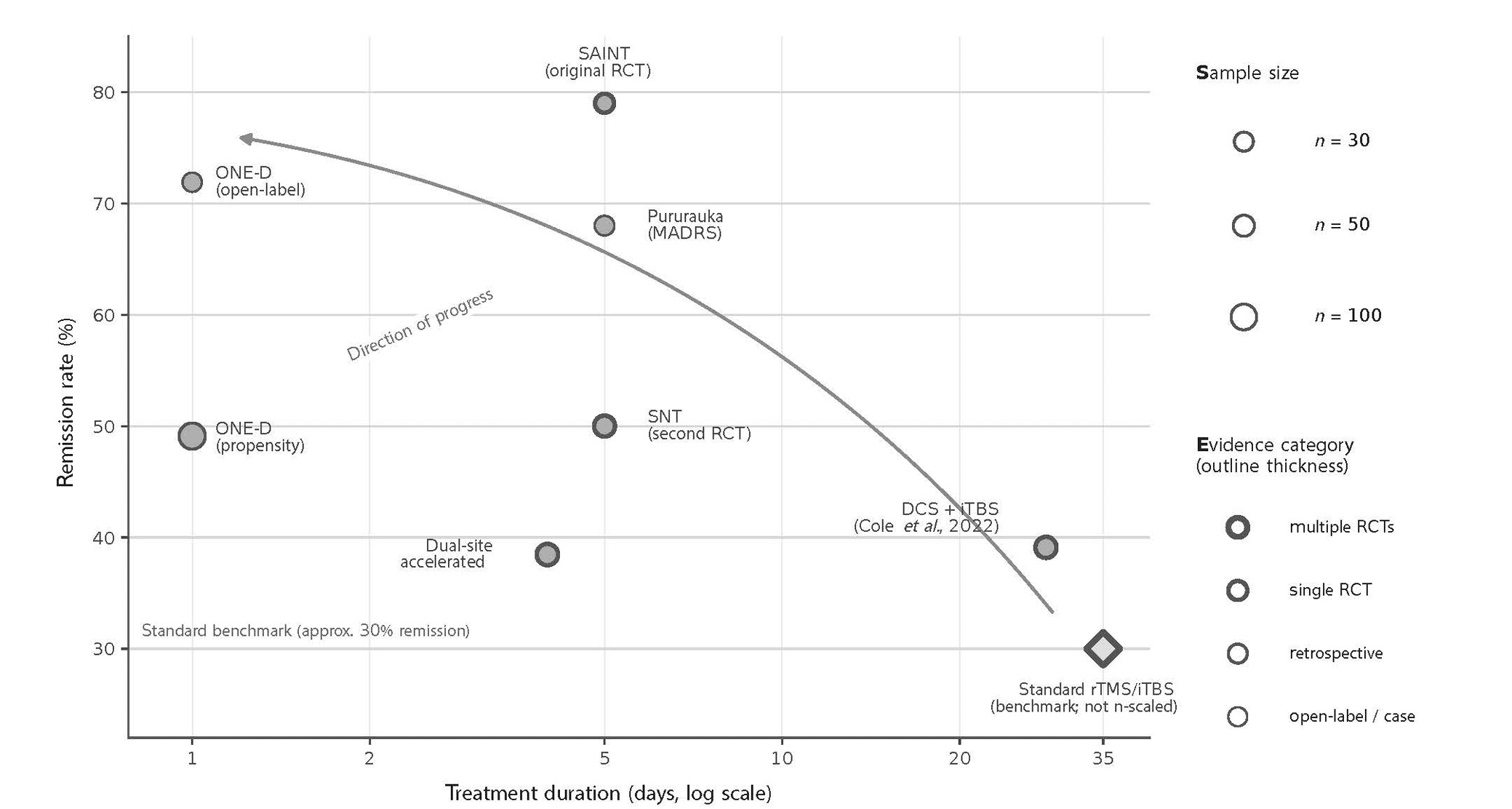
The most extensively studied accelerated protocol is SAINT, which compresses treatment into 50 iTBS sessions delivered over 5 days (10 sessions/day, 50-min intervals, 90,000 pulses) and uses functional connectivity magnetic resonance imaging (fcMRI)-guided individualized targeting of the L-DLPFC site maximally anticorrelated with the sgACC (Cole et al., 2020; Cole, Phillips, et al., 2022). In the original double-blind randomized controlled trial (RCT) (n = 29), SAINT achieved 79% remission on the Montgomery-Åsberg Depression Rating Scale (MADRS), compared with 13% remission noted in the sham group (Cole, Phillips, et al., 2022). In September 2022, the Magnus Neuromodulation System (Magnus Medical, Inc., Burlingame, USA) with SAINT technology received FDA clearance.
The question of whether these findings would replicate in a second, larger trial was addressed in 2026. A second double-blind, sham-controlled RCT (n = 48) reported 50.0% remission compared to 20.8% with sham at 1 month (p = 0.035), closely recapitulating the original trial’s 1-month remission rate of 46.2% (Kratter et al., 2026). Beyond clinical outcomes, the study identified a reduction in left anterior cingulate cortex (L-ACC) beta power as a candidate mechanism, and pre-treatment L-ACC beta power as a scalable EEG biomarker predicting response (R2 = 0.30–0.40). Important caveats remain: the sample was single-site and demographically limited; no direct comparison against conventional rTMS has been conducted; and the 50-min inter-session interval (originally justified by rodent hippocampal slice data) may not be optimal for humans. Two large accelerated iTBS trials that demonstrated equivalence with standard rTMS used 15-min spacing, suggesting that the ideal dosing schedule remains unresolved (Fitzgerald et al., 2026).
A conceptually different approach to acceleration involves engaging multiple circuits rather than intensifying stimulation of a single circuit. Zhao et al. (2025) tested a sequential dual-site protocol in a sham-controlled RCT (n = 52): 4 rTMS sessions per day over 4 days, targeting the L-DLPFC followed by the dorsomedial prefrontal cortex (DMPFC). At week 4, response and remission rates (MADRS) were 57.69% and 38.46% (vs. 23.08% and 15.38% for sham), with over 85% of responders maintaining remission at 6 months. Resting-state fMRI revealed dissociable mechanisms for each target, suggesting that multi-site stimulation may access therapeutic pathways unavailable to single-target protocols (Zhao et al., 2025).
Where dual-site stimulation seeks to broaden therapeutic reach by engaging additional circuits, a complementary logic asks whether intensifying stimulation within the same target can overcome treatment resistance through sheer neuroplastic dose. The Pururauka protocol tested this premise, delivering 180,000 iTBS pulses over 5 days in 36 adults with severe depression and active suicidal ideation, doubling the pulse count of SAINT (Virto-Farfan et al., 2025). Marked symptom reduction was observed (Hamilton Depression Rating Scale (HDRS) decreased from 38.89 to 13.61) and sustained at 6 months, though these pre-experimental results lack a sham control.
Taken together, these protocols illustrate that acceleration can be implemented through multiple strategies, namely temporal compression, multi-site engagement, and dose escalation, rather than representing a single uniform approach. However, the field remains at an early stage. The NNDC/CTMS/IFCN (National Network of Depression Centers/Clinical TMS Society/International Federation of Clinical Neurophysiology) consensus acknowledges accelerated protocols as promising but notes that the evidence is limited to small samples, and SAINT is not yet a clinical standard of care (Trapp et al., 2025). A recent editorial underscores that no single accelerated protocol has emerged as superior. Key parameters (number of daily sessions, inter-session interval, pulse number per session, and stimulation intensity) remain empirically unresolved, with multiple effective configurations likely to coexist (Fitzgerald et al., 2026). The principal protocol parameters and reported remission outcomes are summarized in Table 1 and Figure 1.
Augmentation: Pharmacological optimization of the neuroplastic window
The concept of pharmaco-TMS (Brown and Philip, 2025) posits that TMS provides the directional stimulus (which circuits to change), while pharmacology ensures the optimal chemical environment for plasticity. D-cycloserine is the only agent with RCT evidence for specifically enhancing TMS-induced synaptic plasticity. The ONE-D protocol represents its most comprehensive clinical translation to date, combining pharmacological augmentation with single-day accelerated delivery.
D-cycloserine, a partial agonist at the glycine site of the NMDA receptor (100–125 mg), enhances bidirectional NMDA receptor-dependent synaptic plasticity (Vestring et al., 2024). In a peer-reviewed RCT on depression, Cole, Sohn, et al. (2022) (n = 50) demonstrated a 73.9% response in the iTBS + DCS group vs. 29.3% with iTBS + placebo, with remission at 39.1%, and an effect size of d = 0.99. DeMayo et al. (2025) subsequently identified a serum DCS threshold of 7 µg/mL predictive of response, opening the way for pharmacokinetic-guided dosing. The augmentation paradigm has since extended to obsessive-compulsive disorder, where a triple-blind, sham- and placebo-controlled RCT targeting the medial prefrontal cortex found a similarly large effect (d = 1.34 vs. sham; n = 24), suggesting that NMDA receptor-dependent plasticity enhancementt may represent a transdiagnostic, circuit-general principle rather than a depression-specific phenomenon (McGirr et al., 2025). Secondary analyses of the depression RCT demonstrated rapid reduction of suicidal ideation with concurrent modification of implicit suicide-related cognitive bias, an effect independent of overall depressive symptom improvement (Sohn et al., 2025).
The evidence base for ONE-D is at an early developmental stage. To date, no randomized, sham-controlled trial has been completed. The available data come from a single open-label case series, one retrospective propensity-matched comparison (currently a preprint), a peer-reviewed 5-patient case series, and a single independent case report. The findings reviewed below should therefore be considered hypothesis-generating rather than confirmatory.
The ONE-D protocol (Vaughn, Marino, Engelbertson, Dojnov, Johnson, et al., 2025) represents the most comprehensive implementation of this concept, combining DCS (125 mg) and LDX (20 mg) with single-day accelerated delivery (20 iTBS sessions over 9.5 h, 30-min inter-session intervals, scalp-heuristic targeting of the L-DLPFC). The mechanistic rationale for adding LDX to the ONE-D regimen is biologically plausible but currently entirely speculative. As a prodrug converted to d-amphetamine, LDX elevates synaptic dopamine and norepinephrine, and animal data suggest that catecholaminergic tone may modulate the threshold for NMDA-dependent LTP and prolong post-stimulation plasticity (Brown and Philip, 2025). However, no randomized, controlled, placebo-blinded study has tested LDX as an adjunct to TMS in any indication, and no human study has demonstrated that LDX modifies TMS-induced cortical plasticity, behavioral response, or neurophysiological biomarkers. Therefore, the available data do not permit any inference about whether LDX contributes to ONE-D outcomes; the protocol should be regarded as an empirically untested combination intervention until factorial designs (DCS alone vs. DCS + LDX vs. placebo) are completed. In an open-label series (n = 32; TRD), ONE-D reported 87.5% response and 71.9% remission at 6 weeks (HDRS-17, intention-to-treat). A subsequent propensity-matched retrospective comparison (n = 106 (single-day) vs. n = 191 (once-daily TMS)) found Patient Health Questionnaire-9 (PHQ-9) remission rates of 49.1% vs. 25.1% (p < 0.0001), thereby maintaining the approx. 2-fold advantage over conventional TMS (Berlow et al., 2026). A peer-reviewed case series involving 5 patients confirmed sustained remission at 3–6 months across several protocol variants and revealed a distinctive temporal dissociation between the single-day intervention and full therapeutic response, which in some cases required up to 6 weeks, consistent with a delayed neuroplastic cascade (Vaughn, Marino, Engelbertson, Dojnov, Stine, et al., 2025). A case report from a separate clinical center reported the use of the core ONE-D approach, with a reduction in HDRS-17 from 20 to 2 within 1 week (Middleton et al., 2025). Randomized controlled trials are essential to confirm efficacy of the treatment.
Several methodological limitations should be emphasized. First, the absence of a sham-controlled randomized design precludes any conclusion about specific efficacy vs. placebo or expectancy effects, which can be substantial in TRD trials. Second, the retrospective propensity-matched comparison study (Berlow et al., 2026) is currently a preprint. Third, the relative contributions of single-day delivery, DCS, LDX, and concurrent care cannot be disentangled from the existing data. Fourth, the reports include overlapping authorship and do not yet constitute fully independent replication. A randomized, sham-controlled trial isolating each component is essential before ONE-D can be recommended for clinical adoption.
Precision and personalization: from the 5-cm rule to individualized protocols
Traditional coil positioning relied on the 5-cm rule (5 cm anterior to the motor hand area), which frequently missed the DLPFC entirely (Herwig et al., 2001). Contemporary precision operates at multiple levels, forming a practical good–better–best ladder for clinical implementation. At the entry tier, pragmatic scalp-based rules such as the Beam F3 method (or the original 5-cm rule) allow for rapid targeting without imaging resources; at the next tier, anatomical MRI-guided neuronavigation refines coil placement to each patient’s cortical anatomy; and at the top tier, fcMRI identifies the precise DLPFC point maximally anticorrelated with the sgACC, while electric-field modeling (e.g., SimNIBS), network-based targeting approaches such as Targeted Functional Network Stimulation (TANS), and diffusion tractography further optimize coil orientation (Cash and Zalesky, 2024). This stepped model allows busy community clinics to select an approach matched to available resources and expertise, facilitating broader access to precision TMS without requiring all sites to adopt the most resource-intensive protocols immediately.
Clinical evidence for individualized targeting is growing, but large head-to-head trials remain limited. Connectivity-based targeting is grounded in the observation that antidepressant response is associated with stimulating L-DLPFC sites intrinsically anticorrelated with the sgACC (Fox et al., 2012). Promising clinical outcomes have been reported with individualized fcMRI-guided protocols, including robotically delivered approaches (Hearne et al., 2025). At the same time, consensus guidelines continue to endorse pragmatic scalp-based rules (e.g., Beam F3 or 5.5 cm) when neuronavigation or fcMRI-guided targeting is unavailable, given the cost and workflow complexity of precision pipelines (Trapp et al., 2025).
Beyond spatial precision, personalization extends to the temporal domain and to patient selection – determining when to stimulate and who is most likely to respond. Closed-loop TMS–EEG systems can synchronize pulses with real-time oscillatory activity, aiming to deliver stimulation at temporally optimal phases of cortical excitability. Resting-state EEG is also emerging as a cost-accessible complement to fcMRI for patient stratification: reductions in L-ACC beta power following Stanford Neuromodulation Therapy (SNT) correlate with clinical improvement (rho ≈ 0.5), and elevated pre-treatment L-ACC beta power predicts greater antidepressant benefit (Kratter et al., 2026), raising the prospect of EEG-guided patient selection and adaptive, beta-informed stimulation timing. Emerging work suggests that TMS-derived cortical excitability metrics may extend beyond treatment monitoring toward diagnostic classification of MDD itself, with machine learning models combining novel motor evoked potential (MEP)-derived indices (δ and ρ) achieving >82% accuracy in preliminary studies. However, replication in larger samples is required (López Pereyra et al., 2026). The envisioned multimodal pipeline (diagnostic fcMRI, stimulation guided by diffusion tensor imaging/finite element method (DTI/FEM) modelling, and real-time optimization via closed-loop EEG/magnetoencephalography (MEG) with artificial intelligence (AI)) is technologically feasible at each step; the challenge lies in integrating it into a clinically practical workflow (Cash and Zalesky, 2024; Fitzsimmons et al., 2024).
Positioning TMS in treatment algorithms: Efficacy, safety, and cost-effectiveness
Recent comparative trials are repositioning TMS from a last-resort option to a parallel step in TRD algorithms. In the ASCERTAIN-TRD study (n = 278), rTMS augmentation and aripiprazole augmentation both improved depressive symptoms more than antidepressant switching on the primary Symptoms of Depression Questionnaire (SDQ) (Papakostas et al., 2024). Mean SDQ change was −33.25 (rTMS) and −33.32 (aripiprazole) vs. −28.73 with switching; rTMS also produced greater MADRS improvement than switching (−17.39 vs. −13.22). In a separate randomized trial of antidepressant non-responders, rTMS as the next step yielded substantially higher remission rates than continued pharmacotherapy (27.1% vs. 4.9%) (Dalhuisen et al., 2024). Comparative data against intranasal esketamine remain indirect. An individual participant data analysis using propensity score matching suggested that both rTMS and esketamine outperformed antidepressant medication, with no statistically significant differences between the 2 active treatments (estimated marginal mean difference = −2.46, 95% confidence interval (95% CI): −5.82–0.89) (Kaster et al., 2025).
Beyond efficacy, TMS offers a favorable safety and tolerability profile relative to systemic pharmacotherapy. O’Sullivan et al. (2024) systematically compared rTMS, selective serotonin reuptake inhibitors (SSRIs), psychotherapy, and electroconvulsive therapy (ECT) across multiple domains and argued that conventional rTMS already meets the Canadian Network for Mood and Anxiety Treatments (CANMAT) criteria for first-line status in major depressive episodes. Key advantages include a substantially lower risk of serious adverse events (seizure incidence approx. 1 per 60,000 sessions; manic conversion rate comparable to sham) and higher treatment completion rates (dropout: 7.5–12% vs. 15–19% for SSRIs; compliance: 80–90% vs. 62–66%), the latter being a clinically significant advantage given that antidepressant non-adherence is a major contributor to treatment failure and relapse. These data suggest that rTMS could be positioned earlier in treatment algorithms, not solely after pharmacotherapy failure, particularly for patients with contraindications to systemic medication, a history of intolerance, or a preference for non-pharmacological approaches.
Recent health-economic analyses in Canada and the United Kingdom suggest that rTMS/iTBS is cost-effective relative to pharmacotherapy alone, particularly when services achieve sufficient throughput, further supporting consideration of TMS as an earlier-line treatment option (Cox et al., 2026; O’Sullivan et al., 2024). Downar (2025) introduced the metric of treatment time per remission (TTPR): conventional protocols require over 100 h, accelerated protocols under 20 h, and single-day regimens under 5 h, approaching cost parity with pharmacotherapy.
Maintenance TMS: Sustaining the accelerated response
The long-term durability of accelerated TMS response remains underinvestigated. Two systematic reviews (d’Andrea et al., 2023, n = 847; Wilson et al., 2022, n = 1,494) converge on several conclusions: maintenance TMS significantly reduces relapse rates; at least 3 monthly sessions are needed to sustain response; cluster and continuous protocols outperform single-session monthly schedules; and the risk of relapse peaks approx. 5 months after acute treatment, delineating a critical vulnerability window. Notably, some patients who did not meet remission criteria at the end of the acute course subsequently converted during maintenance sessions, suggesting a “delayed conversion” phenomenon that parallels the delayed neuroplastic cascade described for the ONE-D protocol (see: “Augmentation: Pharmacological optimization of the neuroplastic window”).
A recently published Dutch-Flemish consensus statement provides the most comprehensive framework to date for structuring maintenance practice (Dalhuisen et al., 2026). Based on a systematic PubMed® review of 22 studies (through June 2025) and 2 expert consensus meetings, the panel categorized maintenance approaches into 3 types: tapering (symptom-guided gradual reduction immediately after acute treatment); maintenance rTMS (fixed-interval single or clustered sessions); and retreatment (reinitiating a full treatment course upon relapse). Among maintenance protocols, clustered sessions (specifically 5 sessions per month delivered over 2.5–5 days) showed the most consistent evidence for sustaining remission across open-label studies, while single-session monthly schedules produced inconsistent results. A 2025 RCT comparing weekly maintenance rTMS to lithium over 24 weeks found no significant differences in relapse rates (7 events/group), while the rTMS arm demonstrated substantially better tolerability (Noda et al., 2025). Retreatment upon relapse, repeating the acute protocol, was effective in over 85% of previously responding patients surveyed across Dutch institutions, frequently requiring fewer sessions than the original acute series. The consensus recommendations emphasize individualized, symptom-guided decision-making and structured monitoring (e.g., periodic symptom questionnaires) to identify the optimal time to initiate maintenance or retreatment.
The accelerated delivery model enables a qualitatively distinct, reactive maintenance paradigm. Stimpson et al. (2026) tested personalized continuation therapy (PCT) with SAINT. Twenty-one TRD participants, remotely monitored via wearable biometrics, received symptom-triggered retreatment over 12 months. Participants spent 85.9% of follow-up in remission, requiring a mean of only 2.3 treatment days per retreatment course, with no evidence of tachyphylaxis across repeated administrations. The absence of tachyphylaxis is clinically significant, as it addresses a key concern that intensive stimulation protocols might progressively saturate the capacity for synaptic plasticity. These preliminary findings suggest that accelerated TMS may be amenable to an “as-needed” treatment model analogous to episodic pharmacotherapy. However, confirmation is required in controlled trials with longer follow-up.
Parkinson’s disease and the somato-cognitive action network
Consider a 67-year-old former civil servant with idiopathic PD who, despite optimized levodopa therapy, experiences increasing axial symptoms, namely gait freezing, postural instability, and dysarthria, that respond poorly to dopaminergic adjustment. Such a phenotype, where the limiting symptoms reflect non-dopaminergic circuit dysfunction beyond the cardinal striatal pathology, exemplifies the unmet need that has motivated the reframing of rTMS targets in PD discussed in this section.
Parkinson’s disease offers an instructive case study for integrating acceleration and precision targeting and for motivating future augmentation studies. Transcranial magnetic stimulation has been investigated in PD for decades, with meta-analyses reporting modest motor improvements but high heterogeneity (Yang et al., 2018; Zhang et al., 2022). The fundamental problem has been the absence of a pathophysiology-grounded cortical target. Most trials stimulated the M1 hand area or supplementary motor area based on anatomical landmarks, treating the motor cortex as a homogeneous structure.
Recent work has reframed this problem. Gordon et al. (2023) discovered that the primary motor cortex contains interleaved SCAN regions responsible for whole-body action coordination, arousal regulation, and autonomic control, alternating with effector-specific (foot, hand, mouth) motor representations along the central sulcus. Jensen et al. (2023) independently confirmed a motor association area in the depths of the central sulcus, and Dosenbach et al. (2025) further characterized the SCAN as the brain’s action-mode network. Ren et al. (2026), using a large multimodal dataset (n = 863), demonstrated that 6 subcortical structures central to PD are preferentially connected to the SCAN. The authors noted that PD is characterized by disease-specific SCAN-to-subcortex hyperconnectivity, and, most critically for clinical practice, that all effective PD treatments (deep brain stimulation (DBS), levodopa, TMS, focused ultrasound) converge on normalizing this hyperconnectivity. This parallels the role of the sgACC as a connectivity hub in depression-focused TMS, suggesting that circuit-level targeting may be a generalizable principle across neuromodulation indications.
The same study included an RCT comparing SCAN-targeted vs. effector-targeted iTBS in 36 PD patients (accelerated schedule: 7,200 pulses/day, 14 days). The SCAN group demonstrated approx. twice the motor improvement (Movement Disorder Society-Unified Parkinson’s Disease Rating Scale Part III (MDS-UPDRS-III) reduction: 13.48 points vs. 6.49 points), with gains across all subdomains. Critically, SCAN-targeted stimulation reduced pathological hyperconnectivity, whereas effector-targeted stimulation did not, providing both a mechanistic explanation and a candidate treatment biomarker. The result is noteworthy because all stimulation parameters were identical, except for the cortical target. However, the trial lacked a sham arm, limiting conclusions about the overall effect of TMS compared to placebo. The implications of this absence merit closer examination. Placebo responses in PD trials are typically large — meta-analyses report mean MDS-UPDRS-III reductions of approx. 4–6 points in sham-stimulation arms, occasionally exceeding 8 points in surgical-blind designs. The 6.49-point reduction observed in the effector-targeted arm is therefore within the range plausibly attributable to expectancy alone, while the 13.48-point reduction in the SCAN arm clearly exceeds typical placebo magnitudes. The differential motor improvement and the differential normalization of SCAN-to-subcortex hyperconnectivity together support a target-specific effect. However, the overall efficacy of SCAN-targeted TMS in PD beyond placebo cannot be quantified from this design. A multicenter, sham-controlled trial is the necessary next step.
The SCAN–PD findings invite further integration of the framework. The established glutamatergic dysfunction of basal ganglia circuits in PD (McGregor and Nelson, 2019) provides a rationale for pharmacological augmentation of NMDA-dependent plasticity, though no study has yet tested this combination. The protocol already employed an accelerated schedule; whether further compression is feasible remains to be explored. SCAN-to-subcortex hyperconnectivity as a biomarker could enable adaptive treatment protocols, and EEG-based proxies, potentially derived from beta-band coherence patterns (Mantini et al., 2007), could reduce dependence on fcMRI for SCAN localization. More broadly, the PD trial illustrates a generalizable three-step logic: discover the circuit architecture; characterize its disease-specific dysregulation; and target it individually, a template that may serve for psychiatric applications. However, a critical difference must be acknowledged. Parkinson’s disease has a relatively well-understood neurodegenerative cause that may make it behave as a single pathophysiological entity with a mappable network-level correlate. Depression and other psychiatric disorders likely encompass multiple distinct entities, each potentially involving different network-level dysfunctions (Drysdale et al., 2017). They may therefore require identification of multiple disorder-specific circuit signatures before comparable precision can be achieved.
Beyond depression and Parkinson’s disease
While depression and PD provide the most developed test beds for the 3 principles reviewed here, accelerated, multi-site, augmented, and connectivity-based rTMS protocols are increasingly being explored across the neuropsychiatric spectrum. The most directly analogous example to the depression and PD paradigms reviewed above comes from Alzheimer’s disease. Koch et al. (2022) targeted the precuneus – a key node of the default mode network (DMN) – in a 24-week phase 2 randomized, double-blind, sham-controlled trial, demonstrating slowed cognitive and functional decline in mild-to-moderate AD. A 52-week extension using personalized neuronavigated TMS–EEG to refine the precuneus target confirmed durable benefit across cognition, activities of daily living and behavioral symptoms (Koch et al., 2025). A recent narrative synthesis from the same group situates this program within a broader framework for non-invasive brain stimulation in dementia (Koch et al., 2024). The Koch protocol is notable because it combines acceleration with connectivity-based precision targeting, further refined by EEG-guided personalization. An earlier randomized double-blind sham-controlled trial established proof of concept for combining multi-site rTMS with cognitive training in mild-to-moderate AD (Lee et al., 2016), a complementary augmentation strategy that has continued to inform contemporary multi-target dementia protocols. Beyond AD, sequential, neurocircuit-informed rTMS targeting both the DLPFC and DMPFC has shown promise for bipolar II disorder in adolescents (Luo et al., 2024), extending the dual-site logic developed in adult depression. Accelerated rTMS targeting the primary motor cortex is also under randomized investigation for chronic neuropathic pain (e.g., NCT05295498). For obsessive–compulsive disorder, DCS augmentation of TMS produced large-effect results in a triple-blind RCT (McGirr et al., 2025), as discussed in “Augmentation: Pharmacological optimization of the neuroplastic window”. This finding suggests that the augmentation principle may transfer beyond depression. Comparable efforts are underway in addiction (DLPFC accelerated protocols), tinnitus (auditory-cortex multisite designs), and post-stroke motor rehabilitation. These applications are mentioned for completeness; a comprehensive cross-indication synthesis would warrant a separate review.
Limitations and translational challenges
Enthusiasm must be tempered by critical appraisal. Many key findings are based on small samples (n = 29–36 in the key RCTs for SAINT and SCAN-targeted PD–TMS). The NNDC/CTMS/IFCN consensus (Trapp et al., 2025) explicitly notes that SAINT is not yet a clinical standard. Durability data for accelerated protocols are limited to 4–6 weeks in most studies. Moreover, approx. half of SAINT responders relapsed within 12 weeks in 1 follow-up study, highlighting the need for maintenance strategies (Geoly et al., 2025; Fitzgerald et al., 2026). The SCAN-targeted TMS trial lacked a sham control. While comparing 2 active targets demonstrates the superiority of SCAN targeting, it does not isolate the overall TMS effect from placebo. Multicenter replication is essential.
Precision targeting introduces logistical and economic barriers: fcMRI-guided personalization requires specialized imaging, computational infrastructure, and expertise not yet available in most clinical settings; conventional methods such as Beam F3 have yielded lower response rates in indirect cross-study comparisons. However, dedicated head-to-head trials are still needed (Cash and Zalesky, 2024), as no prospective clinical trial has yet demonstrated superior outcomes for imaging-based targeting over practical scalp-based methods that account for head size, such as Beam F3 (Fitzgerald et al., 2026). Evidence of pharmacological augmentation comes from a single trial (n = 50). The plasticity ceiling concept, which posits that intensive protocols may saturate synaptic LTP capacity, limiting the additional benefit of NMDA agonism, requires empirical testing (Ganesh et al., 2025). However, preliminary data from PCT suggest no tachyphylaxis across repeated accelerated courses (see: “Maintenance TMS: Sustaining the accelerated response”).
Several additional methodological concerns warrant consideration. Protocol heterogeneity across accelerated TMS studies limits direct comparison and impedes identification of optimal parameters. Many key findings originate from a small number of research groups (notably Cole for SAINT/SNT, Downar/Vaughn for ONE-D, and Ren/Zhang for SCAN-PD), raising concerns about independence from replication and investigator allegiance. Available data come overwhelmingly from North American and East Asian cohorts; generalizability to European populations remains untested. Finally, publication bias is a concern, and several cited studies (Berlow et al., 2026; Ganesh et al., 2025) are preprints that were not peer-reviewed.
The present review is narrative in scope, without formal risk-of-bias assessment or meta-analytic pooling. Systematic reviews with pre-registered protocols are needed for each domain discussed here.
Implications for the Polish healthcare context
Translation of the protocols reviewed here into routine clinical practice in Poland will face several practical barriers. Functional connectivity MRI-guided targeting requires resting-state MRI acquisition with individualized post-processing pipelines, expertise that is currently concentrated in academic centers. Reimbursement pathways for accelerated TMS, including SAINT-type protocols, are not yet defined within the Polish public health system, and the National Health Fund (NFZ) reimburses only standard rTMS for TRD in selected centers. Pharmacological augmentation with DCS is feasible (DCS may be sourced via direct import authorization in some European Union (EU) jurisdictions), whereas LDX has been available in Poland since 2023 but remains restricted to attention deficit hyperactivity disorder (ADHD) indications, requiring off-label use under appropriate institutional governance for any TMS-augmentation application. We therefore anticipate that the most immediately translatable advances for Polish settings are: 1) accelerated iTBS schedules using scalp-based targeting (Beam F3), which require no additional imaging infrastructure; 2) DCS augmentation, contingent on protocol approval and drug sourcing; and 3) the conceptual framework of circuit-based targeting, which may inform research collaborations with centers possessing fcMRI capability.
Conclusions
Transcranial magnetic stimulation is entering a phase of active development defined by the convergence of acceleration, augmentation, and precision targeting. Together, these principles share a simple aim: to maximize the biological impact of each stimulation session by delivering treatment efficiently, within a neuroplasticity-optimized milieu, and to the right cortical target for each patient.
Parkinson’s disease illustrates the integration of acceleration and precision targeting particularly clearly; pharmacological augmentation remains a testable extension. The demonstration that SCAN-targeted stimulation approx. doubled motor improvement over effector-targeted stimulation (using identical parameters) provides initial evidence for circuit-informed target selection. However, the absence of a sham arm and the small sample (n = 36) require confirmatory trials before clinical adoption.
Across indications – from TRD, where TMS is increasingly positioned alongside pharmacotherapy and esketamine, to PD, where circuit-level targeting has shown early promise – these 3 principles provide a framework for ongoing clinical innovation. The TTPR metric (Downar, 2025) suggests that accelerated and augmented protocols may eventually bring TMS toward cost parity with pharmacotherapy, though this depends on achieving sufficient clinical throughput. Current priorities include adequately powered multicenter RCTs, scalable precision-targeting workflows, systematic pharmacological augmentation trials, and biomarker integration to enable adaptive, individualized treatment. For the patient described in our introduction, the 42-year-old teacher who has exhausted standard pharmacological options, these developments suggest that a single day of pharmacologically augmented TMS, even with scalp-based targeting, may warrant evaluation as an alternative to prolonged medication adjustment, pending confirmation in controlled trials.
Ethics approval and consent to participate
Not applicable.
Data availability
Not applicable. No datasets were generated or analyzed for this narrative review.
Consent for publication
Not applicable.
Use of AI and AI-assisted technologies
During the preparation and proof revision of this manuscript, the authors used ChatGPT (OpenAI, San Francisco, USA) and Claude (Anthropic, San Francisco, USA) to assist with language and structural editing, reference checking, and the preparation and revision of Figure 1. All AI-assisted material was critically reviewed by the authors and, where relevant, checked against the cited sources. The authors take full responsibility for the final content. These tools were not used to generate or analyze study data.